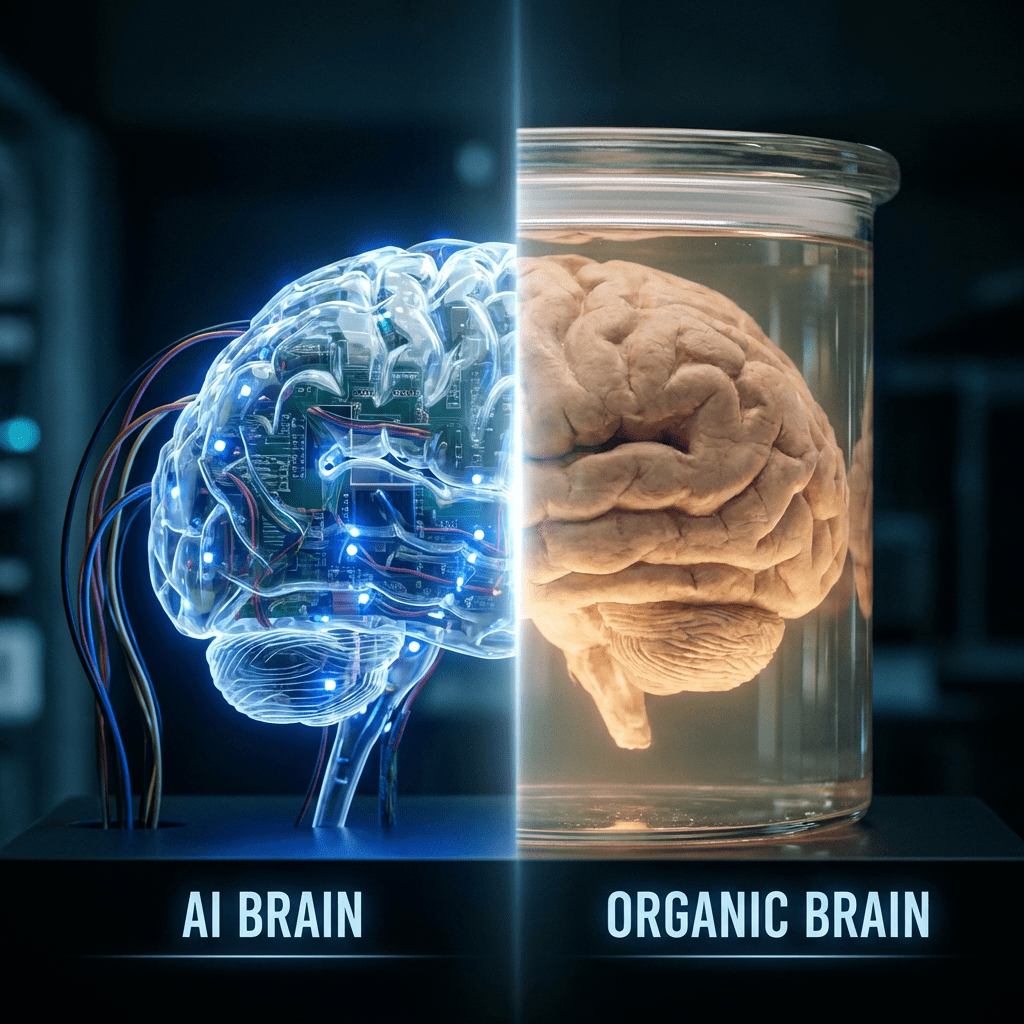
I have spent years at the intersection of artificial intelligence and human performance. During the day, I build AI systems. At night, I coach senior professionals. And the single most dangerous belief I faced, in both worlds, is this:
“If I just learn more, I’ll stay relevant.”
It sounds sensible. It’s quietly devastating.
The Crisis Nobody Is Talking About Honestly
Let me be direct about what’s happening to professionals. The LinkedIn version of this conversation is far too polite.
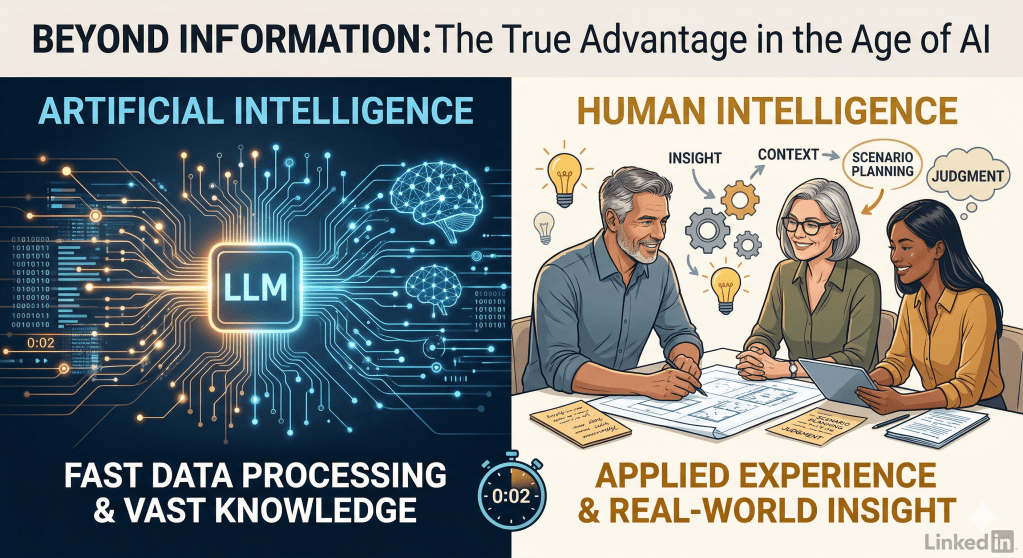
AI is not coming for your job. It already has your information. You studied every framework. You were certified in every methodology. You memorised every process. An LLM can retrieve, articulate, and present these more fluently than most humans. It does this in under three seconds, in seventeen languages, without a coffee break.
I watched a senior consultant — fifteen years of experience, top-tier MBA, genuinely brilliant — spend six hours preparing a strategic framework for a client. A junior team member with a good prompt produced something structurally identical in forty minutes using Claude.
The consultant was shattered. The junior was smug. Both were missing the point entirely.
Because here is what the AI didn’t produce in those forty minutes: it didn’t know that the client’s COO was three months from retirement. The COO was quietly sandbagging any initiative that would outlast his tenure. It didn’t sense that the organisation’s stated problem wasn’t its real problem. It didn’t know which recommendation to not put in the report because of a relationship dynamic that existed three restructures ago.
That consultant’s fifteen years weren’t in the framework. They were in the room.
Information Is Not Knowledge. Knowledge Is Not Wisdom.
We have confused three things that are fundamentally different, and AI has made that confusion catastrophic for professionals who haven’t noticed.
Information is data in structured form. The textbook definition of Lean Six Sigma. The steps of a DMAIC cycle. The formula for calculating NPS. AI has all of it, instantly and perfectly.
Theoretical knowledge is information you understand — you can explain it, teach it, pass an exam on it. Most professional education produces this. It is genuinely valuable. It is also table stakes, because AI has it too.
Real knowledge — applied knowledge — is something else entirely. It is what happens when information collides with reality repeatedly. It fails, gets adjusted, and fails differently. It gets adjusted again and eventually produces judgment. It is not stored in books. It cannot be scraped. It integrates with the nervous system. It belongs to someone who has been present when things went wrong. This person figured out why.
Here’s a simple test I use with the professionals I coach:
Can you tell me about a time your instinct contradicted the data — and you were right?
That story, whatever it is, is your real knowledge. The scar tissue of applied experience. AI cannot fake it. More importantly, AI cannot replace it, because the next client’s messy, specific, politically loaded, emotionally charged situation will never be identical to any situation in the training data.
The gap between knowing about something and knowing how something actually behaves in the wild — that gap is where experienced professionals live. That gap is the moat.
So Why Are So Many Experienced Professionals Losing Confidence?
Because they are competing on the wrong dimension.
When AI arrived, most professionals responded in one of two ways. The first group panicked and started collecting certifications — AI literacy courses, prompt engineering badges, digital transformation credentials. They are running faster on a treadmill, accumulating more information to compete with a system that will always have more information.
The second group dismissed AI entirely, convinced that experience alone is a permanent shield. They are standing on a sandbank, watching the tide come in, confident it won’t reach them.
Both groups are misreading what the moment requires.
The professionals who are genuinely thriving — and I work with them closely enough to say this with conviction — are doing something different. They are using AI to eliminate the low-value application of their knowledge, so they can deploy the high-value application more intensively.
They are not trying to out-process AI. They are out-judging it.
What Professional Growth Actually Looks Like Now
Professional growth in the age of AI is not about knowing more. It is about converting what you know into irreplaceable judgment, faster.
That means three shifts that most professionals resist because they feel uncomfortable:
First, stop hoarding information and start codifying your failures. The experiences that built your real knowledge are mostly ones you’d rather not repeat. The client engagement that nearly fell apart. The project that overran by six months. The recommendation you made that turned out to be wrong. These are your most valuable assets and almost no one reflects on them systematically. AI can handle clean, well-structured problems. Your value is in the messy ones — and your edge grows every time you extract a transferable principle from a difficult experience.
Second, develop the skill of contextual translation. Knowing that a process is inefficient is information. Knowing which inefficiencies matter to this leadership team, given this culture, at this point in this business cycle — that is applied knowledge. The professionals commanding the highest fees and the most trust are those who have developed an almost uncanny ability to read context. This is trainable. It requires deliberate practice, not more courses.
Third, build a point of view, not just a knowledge base. AI generates answers. What the world desperately needs — and will pay for — is someone who has lived enough to have a genuine perspective. Not a best practice. Not a framework. A view, grounded in experience, about what is actually true and what merely sounds true. That is the rarest thing in a world flooded with AI-generated content that is technically accurate and experientially hollow.
Insight Is the New Currency — But You Have to Mine It
The write-up that prompted this blog contains a line I keep returning to: insight is the new currency. I agree completely. But currency is only valuable if you can access it, spend it, and grow it.
Most professionals are sitting on a gold mine of applied experience and treating it like landfill — something to briefly mention in an interview before talking about certifications again.
AI has done something quietly extraordinary for us, if we choose to see it that way. It has automated the retrieval and presentation of information so thoroughly that information itself has become nearly worthless as a competitive differentiator. What that leaves — the only thing it cannot touch — is the compounded judgment of someone who has done the work, in real contexts, with real consequences, over real time.
That is not a consolation prize. That is the whole game.
The question is whether you know how to surface it, articulate it, and deploy it with the same confidence that previous generations deployed their technical expertise.
A Final Thought — And I’d Genuinely Like to Hear Yours
I have seen AI make brilliant professionals feel irrelevant and mediocre ones feel invincible. In almost every case, the feeling was wrong.
The professionals who will define the next decade are not the ones who know the most, or who use AI the most fluently. They are the ones who have done enough real work, in enough real situations, to have developed judgment that no model can replicate — and who are conscious enough of that fact to lead with it.
AI is the most powerful information retrieval and synthesis tool ever built. You are something it cannot be: a practitioner who has felt the weight of a decision, lived with its consequences, and grown from both.
Now I want to turn this over to you.
Think about the last time your on-the-ground experience led you somewhere that no AI output, framework, or best practice would have taken you. The moment your instinct overrode the data — and it was right. The client conversation where what you didn’t say mattered more than what you did. The decision that only made sense because of something you’d lived through years earlier.
That is your real knowledge. That is your edge.
What does it look like for you — and are you leading with it, or leaving it on the table?
Drop your story, your pushback, or your perspective in the comments. This conversation only gets valuable when practitioners who’ve actually done the work start sharing what they’ve learned.
#FutureOfWork #ThoughtLeadership #ArtificialIntelligence #ProfessionalDevelopment #CareerGrowth #AIandBusiness #HumanIntelligence #PerformanceCoaching #Leadership
 Corporate Dronacharya
Leave a comment